Monday, April 19, 2010

2010 Aston Martin Gauntlet Concept

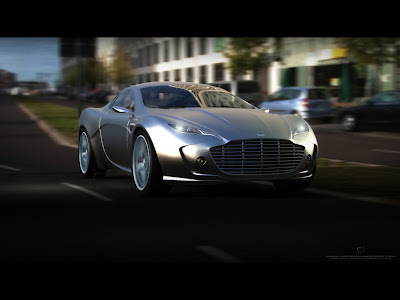
2010 Aston Martin Gauntlet Concept Design by Ugur Sahin

The main goal of the Aston Martin Gauntlet Concept was to design a car which is technically almost identical to the existing production Aston Martins while defining a design character that outmost respects the impressive history of the brand and combine the timeless lines of the past Aston Martins with the modern interpretation of the existing styling.
2010 Aston Martin Gauntlet Concept Design by Ugur Sahin
2010 Aston Martin Gauntlet

Wednesday, February 24, 2010

Land Rover LRX to Debut at Paris Auto Show

Land Rover LRX

Land Rover will debut its newest and smallest model at the Paris Auto Show later this year based on the LRX concept first shown at the Detroit Auto Show back in 2008. Originally thought to be a 2011 model, Automotive News is reporting that it will arrive in late 2011, likely as a 2012 model year vehicle.

According to an older press release released by the automaker the upcoming LRX (if that is in fact its name), will be, “the smallest, lightest and most efficient vehicle the company has ever produced.”

2010 Range Rover Sport Supercharged

2010 Range Rover Sport Supercharged

Despite enduring a string of financial hardships, Land Rover still enjoys one of the clearest and most robust brand identities in the automotive kingdom. The English automaker has held the same core values since the company's first off-roader was created by Maurice Wilks in 1948. Wilks reportedly designed the first Land Rover to emulate a Jeep he had driven, and the first Land Rover prototype actually utilized a chassis borrowed from that legendary American off-roader. And much like Jeep, when you think of Land Rover, the words rugged, purpose-built, and capable are sure to come to mind, but the two storied marques part company when it comes to luxury amenities. England's four-wheeling pride and joy can be found in places like Africa, the Middle East, Australia's Outback and as well as the ritziest precincts of Beverly Hills and Monte Carlo.

Monday, February 8, 2010

Review Volkswagen Passat CC

Volkswagen Passat CC

As motoring journalists, we’re very lucky to have the newest and shiniest cars in town parked in our porch. After awhile, the “immune system” gets build up to a level that only the very captivating will leave a mark.

The Volkswagen Passat CC is one such car because it’s such a beauty. I caught myself looking back everytime I walked away. I unrolled the curtains so I could occasionally look at it while reading the papers. Such was the effect.

Continue reading the report after the jump.

Volkswagen Passat CC

While the Passat CC looks pretty good in pictures, only in real life does it create the abovementioned symptoms, like the captivating girl you remember so vividly one week after that brief five-second encounter.

The CC is not so much a makeover of the standard Passat, but it’s as if this was the original sketch VW designers came up with before sensibility took over. Personally, I think that this car looks better than the Mercedes-Benz CLS, which we presume was VW’s inspiration for its four-door coupe.

Volkswagen Passat CC

Like the CLS, the Passat CC sports a wider, lower and sleeker shape over the car on which it’s based on, and it shares no body panels with the normal Passat.

To be exact, the CC is 34mm longer, 35mm wider and significantly, sits 55mm lower. This, plus the high and rising waistline results in a slim glasshouse which contributes to the CC’s coupe aspirations. Oh, and aren’t those turbine 18-inch alloys sexy?

Volkswagen Passat CC

The frameless doors also do their part in adding sense of occasion. Open them and you’ll find a sumptous cabin in tan leather. Perhaps VW has gone overboard in trying to make the Passat CC special by having just two individual rear seats; while it was just nice for my family of four, the lack of seating for five could be a potential deal breaker for many.

Moving on, while the basic dash design is carried from the normal Passat, the cozy and cocooning surroundings (you sit much lower too) and the very luxe Nappa leather makes it all feel a tad more exotic. The brushed aluminium trim is convincing and VW’s excellent RCD 510 system (not found in GTI/Scirocco) is a welcome inclusion – the full colour touch screen unit incorporates a rear parking camera and ParkAssist, which gives a bird eye’s view of the car relative to obstacles. Just as well, because outward visibility – especially the over the shoulder rear three quarter view – isn’t great, thanks to the small glass area and thick pillars. Coming out of junctions could prove tricky too.

Monday, December 21, 2009

Honda Accord Crosstour

Honda Accord Crosstour

Honda Accord Crosstour

Consider the new Honda Accord Crosstour, which joins a nascent group of vehicles trying to carve out a niche between conventional sedans and crossover utility vehicles, which are themselves supposed to be more carlike than truck-based, body-on-frame S.U.V.’s. The Crosstour slides into Honda’s lineup between the Accord sedan and the Pilot utility vehicle. Other similar new entries are the Toyota Venza, Acura ZDX and BMW 5 Series Gran Turismo. All have a sloping fastback on a slightly oversize crossover body. Any could play the lead if Pixar followed up its movie “Cars” with “The Hatchback of Notre Dame.”

The problem is, fastbacks look good only on small cars, a lesson that carmakers relearn every decade or so. In the 1960s, the Rambler Marlin was the teacher. In the ’70s, it was the A.M.C. Matador coupe. At the end of that decade, Buick and Oldsmobile saddled their Century and Cutlass Salon models with sloping rear ends before quickly reversing course amid public revulsion. More recently? Well, need we mention the Pontiac Aztek?

In pictures, the Honda Accord Crosstour looks like a four-door Accord onto which a big, sloping rear end has been grafted. Seen in person, it’s clear that the Crosstour is a bigger — longer, taller — car. Indeed, the two share no exterior body panels.

What’s surprising is that the bigger Crosstour has no more passenger room. (The difference is less than 1 percent, as measured by the Environmental Protection Agency.) In the Crosstour, the driver and passengers sit about two inches higher, and the car easily accommodates a six-foot passenger behind a six-foot driver. There’s also no crouching down — or climbing up — to get in.

Inside, you see a dashboard lifted from the Accord. The Crosstour doesn’t bother with the regular Accord’s lower trim levels. It starts as an EX for $30,380 — that’s $2,865 more than an EX sedan. The EX-L, at $33,280, adds leather and a few minor niceties. EX-L buyers are invited to spend even more on a navigation system with backup camera ($2,200) and all-wheel drive ($1,450).

Thursday, December 17, 2009

Ford Escape Hybrid, 2010

Inclement weather or and off-road treks are always good ways test an SUV. I didn’t do either in my week with the Escape. But a solid week of mixed city and freeway driving also gives a good idea of a vehicle’s versatility. In parking lots, vision is fine for what seems to be all-too-tight conditions in modern-day malls. On the freeway, the Escape handled itself with confidence. In the SUV segment, the Escape is quiet on the open road.

Ford Escape Hybrid

Ford Escape Hybrid Interior

There’s ample comfort for front and rear-seat passengers and everything is designed cleanly, if conservatively. The look is square, not curved. Functionality rules over any semblance of plushness. Still, the look is handsome considering the segment. Black plastic dominates the console, and it’s attractive. It’s also likely prone to easy scratching.

Dials, knobs, door handles, the glovebox and cupholders are easy to use, with the illuminated cupholders a clever idea not found in many luxury vehicles. Leather seats are optional and the beige seats matched against the black console works like a pair of saddle shoes.

Ford Escape Hybrid Exterior

Manufacturers are keen on trying different color shades. Green was once the most popular color choice for cars, but it was long ago replaced by white. The exterior paint color of my weekly test drive Escape was Kiwi Green Metallic. It’s not a neutral color choice by any definition. It’s an all-or-none color. I thought the color looked classy; Plenty of friends disliked the color. The boxy body style has remained unchanged since 2008.

Ford Escape Hybrid
Ford Escape Hybrid Performance

When braking or decelerating, the Escape’s hybrid system uses regenerative braking, where the electric drive motor becomes a generator, converting the vehicle’s momentum back to electricity for storage in the batteries.

With 155 hp (116 kW), the Hybrid Escape has nearly the same acceleration performance as the conventional 200 hp (150 kW) V6 Escape.

As a result, the hybrid’s acceleration in my experiences during the past few years, remains the same as the non-hybrid — with one exception. On step inclines or long, steady grades, the hybrid is underpowered.

Likes:

Illuminated entry.

Illuminated (bright blue) cupholders.

Handsome coordination of blue and red back-lighting on instrument panel.

Crisp digital radio and rear view camera screen.

Comfortable seats.

Dislikes:

Black plastic on console. Looks clean, scratches easily.

Must release foot brake by hand. It’s not an easy reach.

2010 Ford Escape Hybrid LTD: Facts & Figures

Acceleration: 0-60 mph (8.9 seconds, gas engine); hybrid untested.
Airbags: Front, front side and side curtain airbags.
Antilock brakes: Standard
First aid kit: N/A
Fuel economy (EPA estimates) 34 mpg (city), 31 mpg (highway)
Government Safety Ratings: Front driver/passenger (five stars); Side crash frojt (five stars), rear seat (five stars); Rollover (three stars).
Horsepower: 155.
Manufacturer’s Suggested Retail Price: $32,260.00
Price As tested: $35,775.00
Warranty: Bumper to bumper, 3 years/36,000 miles; Powertrain, 5 years/unlimited miles; Corrosion, 6 years/100,000 miles; Roadside Assistance, 5 years/60,000 miles.
Web site: www.fordvehicles.com.

What Others Say:

“The Escape is a hybrid SUV with solid moves at an affordable price for which no excuses need be made.”
—- Car and Drive.

“The Escape Hybrid is also a very functional mini-SUV that’s enjoyable to drive and quite dependable.”
—- CNN Money.

“The Escape Hybrid delivers a unique combination of hybrid fuel efficiency, SUV utility and a sort of rugged and refined style that’s appropriate for both downtowns and campgrounds.”
—- Kelley Blue Book.
Tuesday, December 15, 2009

2010 Kia Soul

Designed in California and manufactured in South Korea for a global market, the Kia Soul joins the expanding and economical box-style segment manufacturers prefer to call mini MPVs (multi passenger vehicles). The Scion xB and the Nissan Cube are competitors.

The Soul debuted at the Paris Motor Show in 2008, it was first available in February 2009 in Europe and a month later debuted in North American dealerships.

With its varied trims, engines, colors and accessory options, Kia proudly declares the 2010 Soul is available in more than 10,000 combinations.
outsidesoul
The Weekly Driver Test Drive

By coincidence, I drove in consecutive weekly test drives, the Nissan Cube followed by the Kia Soul. Both vehicles are innovative and in some ways, they’re a lot of alike — versatile, Utilitarian Hatchback Vehicles or UHVs (I made up the term.)

I primarily drove the Soul in city jaunts, the grocery store and other routine life tasks. Like the Nissan Cube and Scion xB, it’s nimble and a lot of fun while scooting around town. Parking lots, parallel parking, U-turns — all easily handled.

I’m about as far removed from being a soccer mom as possible. And nor am I a youth baseball coach. The trio of box cars leaders won’t car the whole team and the supplies. But the Soul is a good, economical alternative for transporting about half the team.
insidesoul
Kia Soul Interior

The Soul is the first Kia that breaks the manufacturer’s traditional simple equation: economy means boring. The instrumentation panel and console features are still straight-forward, but they’re now curved and come in color patterns, matched with an interior decorator’s closest of upholstery offerings, including two-tone and sometimes non-matching seats and console.

One oddity: There’s plenty of leg and head room. But that means Kia has opted for the comfort of the passengers (a good thing), and not a lot of room for passengers’ stuff.

Kia Soul Exterior

While grouped in the box-and-wheels segment, Kia Soul designers have taken the best features of other models, like the Sonata, and incorporated those curves and refinement into the Soul. It’s the most stylish of the three major players in the class.

Kia Soul Performance

I like manual-drive cars, and it’s a treat to shift gears in a vehicle one might expect to be offered only as an automatic. The five-speed manual shifts smoothly and the zero to 60 mph standard test rating of 8.8 seconds seems soft. The Soul seems surprisingly quick for its segment and its 2.0-liter, 142-horsepower numbers. Neither the Cube nor Soul are quiet on the highway, but the Soul ride gets more bumpy at higher speeds. The 18-inch wheels help the cause.

Likes:

Like all Kia models, the good-value pricing and industry-leading warranty are hard to ignore.

What’s your favorite color or three? The Soul has a near unlimited supply of color schemes.

Great head and leg rooms for front and rear seat passengers.